
















SPEAKERS PROBABLY THE MOST IMPORTANT PART OF YOUR CAR AUDIO SYSTEM (Part 1 of 2)


EARS AND SPEAKERS – CLOSER THAN YOU THINK
Where does the music we love so much come from?
Of course, you will tell me it comes from artists, from musicians, and I will agree! BUT did you know that sound, as simple as it may seem to your ears, is fundamentally just a simple movement of air? This air movement is essentially generated by a membrane (our vocal cords, a guitar string, etc.) vibrating and moving the surrounding air, or, in the case of our car audio system, generated by our speakers, which do most of the work for sound reproduction.
So, the music you hear from an acoustic guitar, for example, as harmonious as it may be, is an air movement generated by the vibration of the strings pushing the air from the immediate environment in the form of vibrations. These vibrations are passively amplified by the guitar's soundbox, and this generated air movement is then projected into the environment as sound waves (air vibrations). The perceived intensity of these waves varies depending on the power of the source and the distance between the guitar and your ears. In short, without air, you won't have any music!
Once transmitted, these vibrations are picked up by the outer ear and sent to the eardrum, a rigid membrane highly sensitive to air movement and pressure. Upon contact with these waves, the eardrum vibrates. The eardrum then transmits these vibrations to the internal organs of the ear: the malleus, incus, and stapes, which act as amplifiers. At this stage, the waves are approximately 20 times stronger than in the eardrum. The inner wall of the cochlea, containing sensory hair cells bathed in fluid, will then be excited by these vibrations, triggering electrical nerve impulses that travel to the brain via the auditory nerve. This is called transduction.
So here we are at the point where I see you're puzzled by all this talk of anatomy and physics! Don't worry, this will soon help you to understand the acoustic chain and the importance of certain key elements, including, most importantly, the heart of our topic today: SPEAKERS!

Trust your ears!
Whether through amplification, transformation processes, signal capture, or transmission, your ears share many similarities with a recording studio and the audio systems that reproduce music. The elements of "playback" and "amplification" must, in principle, remain impartial and neutral, meaning they shouldn't degrade or color the signal, which isn't always the case in our electronic world, but is generally quite accurate with good-quality equipment.
The same applies to the elements at the source and destination, which, in my opinion, are the most critical for your musical listening experience. Let me explain… With age, the internal structures of our ears, like certain other parts of the body, lose their flexibility and agility, and therefore, our ability to perceive higher frequencies is affected. These now more "rigid" structures require greater airflow and stronger vibrations to be properly stimulated. Hence the hearing loss that begins with high frequencies, as these are normally finer and of lower amplitudes.
This is similar to a microphone capturing air vibrations in a recording studio. If it isn't perfectly suited to the intended use, or if it's a poorly designed unit, it won't be able to adequately convert the perceived vibrations into the electrical impulses required for recording. There's no magic involved; no matter how good the downstream components are in a recording studio, a mediocre microphone will only produce mediocre recordings.
Just like your ear, this microphone transforms an air vibration into an electrical impulse. This process is a crucial step: far more complex than simple reading or electrical processing, such as amplification. Although there are transformations, everything remains within the same electrical domain, which is far from the case for the microphone. The microphone allows us to completely change the type of media by generating electrical information using air pressure (vibrations). In order to have a linear frequency response and accurately capture all the subtleties of acoustic information, this microphone must be constructed using a lightweight yet rigid diaphragm (similar to the eardrum of your ear). This diaphragm moves with the slightest vibration, but without deforming during these movements, thus maintaining its linearity and transmitting only the captured information, nothing more, nothing less. If this diaphragm deforms under vibrations (mechanical distortion), the microphone will inevitably generate unwanted electrical impulses (artifacts) and, therefore, audio noise that will pollute our musical source… AND WE DON’T WANT THIS!

KEEP THE GOOD VIBES, AND ONLY THOSE!
Just like a poorly tuned guitar or a low-quality microphone, a speaker that can't faithfully and harmoniously reproduce your music source will be far from pleasing to your ears! To draw another comparison, and just as your ear or a microphone does, a speaker transforms musical information from one type of media into another. However, since a speaker is a sound emitter and not a receiver, this transformation occurs in reverse. It converts the electrical current of the audio signal into a magnetic field opposing its magnet to generate air pressure (vibrations) using a cone or dome (diaphragm) attached to its motor (the speaker's voice coil and magnet). Essentially, it's the equivalent of a microphone in a recording studio, but at the other end of the acoustic chain AND that's why speakers are so important within your car audio system!

Speaker Basics – How it’s made
Since a speaker is very similar in concept to a microphone or your ear, you will easily understand that a speaker also shares significant technical similarities in the components required for its construction.
- The lighter the speaker cone, the easier it is to move, and therefore the more powerful the sound transmitted to your ears. But above all, this allows the speaker to move more quickly and retain all the dynamics that are mandatory for musical reproduction.
- The more rigid a cone is, the more it can move air without deforming, and therefore the more faithful it is to the original source and with lower distortions, which logically translates into better sound quality.
Unfortunately, in our physical world, these two points are difficult to achieve at the same time. To obtain a rigid cone, we must use more rigid and therefore heavier materials, or use more of the same material to increase its rigidity. This will, unfortunately, have the impact of increasing its mass and, consequently, increasing its inertia, resulting in a speaker that needs a greater driving force to perform the task.
You also need to keep in mind that, the lower the frequencies are, the more difficult it is to move the air to generate sound. Therefore, bigger speakers are needed to reach the required levels at those frequencies, resulting in a heavier cone, which requires more power to reach the same output level as a smaller speaker. This is typically why we find subwoofers on the market with power ratings 3 to 5 times higher, if not more, than the typical power rating for a full-range speaker.

Speaker Basics – The One-Size-Fits-All Does Not Exist
Because higher frequencies require faster piston movements (speaker cone or dome) than mid and low frequencies to generate air displacement, and low frequencies require bigger/heavier units, it's virtually impossible to design a speaker with the perfection of the human ear… at least if you want to stay within a realistic budget for your audio system! It's impossible to have only one speaker do all the jobs.
-
The higher the frequencies to be reproduced, the faster and more precise a speaker must be in its movements.
- Lightweight materials are required for accuracy in transients and faithful reproduction of the audio source.
- Significant structural rigidity is required for acoustic accuracy, minimizing mechanical distortion of the dome.
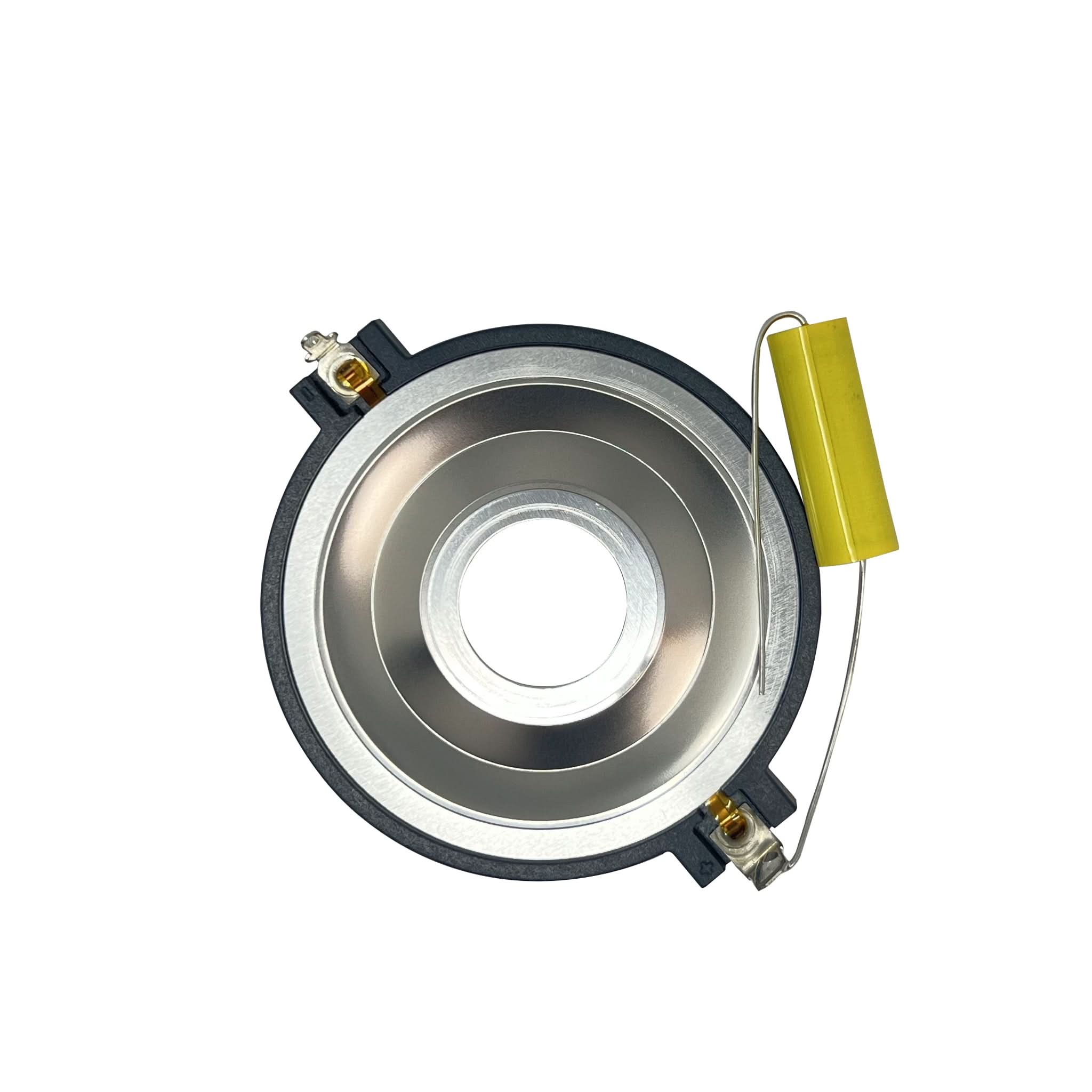
- Small physical size is possible due to the ease of transmission of those frequencies, requiring less thrust than it is for low frequencies.
- A good tweeter will offer you all the musical details without being too prominent or "aggressive," as many people are saying.
-
The lower the frequencies to be reproduced, the bigger a speaker must be, but also more rigid to maintain movement without mechanical distortion.
- A larger motor structure (cone / coil / magnet) is required due to the difficulty of sound transmission, demanding very high thrust amplitudes to generate the necessary air movement to generate those good vibes.
- Very high structural rigidity is required for acoustic precision, minimizing mechanical distortion of the cone to give you a clean and tight bass.
- Lightweight materials are required for an accurate transient response and faithful reproduction of the source and a clean and quick bass attack when required.
- A good subwoofer will deliver all the bass and its musical vibes while maintaining quick and precise control to reproduce only the notes of your recording and avoid any poor transition to the midrange frequencies.
-
For the midrange frequencies, we must find a balance between the high and low frequency requirements.
- Structural rigidity is essential for a smooth and natural transition between the bass and midrange frequencies.
- Lightweight materials are also required for accurate transient response and faithful reproduction of the source to deliver precise vocals and natural dynamism.
- A good midrange speaker will offer warm acoustic, natural and balanced vocals, and the necessary acoustic details without being too bright.
As you can see from these descriptions, it would be difficult to find a speaker that perfectly ticks all these boxes, and that's why I’m saying that the perfect design for a speaker does not exist; This will always be a question of balance/trade off and a choice to improve one characteristic to the detriment of another.

Speaker Basics – The environment has a huge influence.
When shopping for car speakers, it's extremely important to consider that the car environment is very different from your living room or the home theater you have at home.
Although they are both speakers, a home speaker and a car speaker are not built the same way. The car environment is, of course, more demanding for a speaker, due to both temperature and humidity variations, not to mention the physical requirements to install those in your car.
Here are the important points to consider for your car speakers to confirm the right physical fit:
-
Is it compatible with your car and your needs?
- Is it the right shape and size?
- Do you have enough clearance to accommodate the speaker's depth?
- Does the magnet clear the door window?
- For a coaxial speaker, do you have the required clearance, or will the tweeter interfere with the door trim?
-
Does your car's configuration require adapter plates?
- to fit your metal sheet,
- to provide sufficient rear clearance,
- or to perfectly match the door trim.
-
Are the materials used to manufacture the speakers able to withstand various elements?
- Temperature,
- Humidity,
- Vibrations,
- Etc.
In addition to dealing with this environment, a car speaker must also incorporate different components and designs to deliver an acoustic experience that differs from what you would typically find in a speaker used in your home. Those factors greatly influence automotive acoustics and will, therefore, have a significant impact on the acoustic performance of your speakers once they are installed in your car:
-
A smaller listening environment.
- impacting how bass response will be,
- and impacting how sounds will be perceived.
-
Speakers positioned away from the typical “sweet spot” relative to the listener.
- Different distances between the speakers and the listeners.
-
Different speaker positions and angles,
- the angles and positioning of your tweeters,
- or speakers in the doors.
- or again installed on the rear deck
-
Different installation heights & angles;
- tweeters on the dash close to the windshield,
- woofer installed in the lower section of the door),
- speakers in the doors, facing one direction,
- speakers on the read deck facing another.
- Different materials, shapes, and textures in the cabin greatly influence how sounds are propagated and reflected in your environment.
- Etc.

HOW TO MAKE A SIMPLE, BUT GOOD CHOICE?
Listen to Your Ears... And Emotions
I'm sure that simply reading these criteria has already sparked some thoughts on your part. That's why I encourage you to try the following exercise when you are listening to different speakers in the store, so you can carefully select the best product that meets your needs.
The Music You Know
First, and this is crucial for this exercise, make sure you have a music selection you know and enjoy on a regular basis. This is the foundation of good analytical listening. If you listen to well-recorded music, but unfortunately, you don't know this music at all, you'll have no reference to confirm if what you're listening to is good or not. So, have your favorite music handy!
The Way You’re Listening to It
Another important point, in addition to your music selection, is to listen to the music files you normally listen to. Are you listening to music in a lossless format like a FLAC file? Are you listening to your music from a streaming service? Here, I strongly encourage you to do the same when selecting your speakers. Why? Simply because the performances and acoustic responses will differ depending on your source quality and format, and therefore will have a significant impact on the speaker's acoustic response. For example, if you listen to streamed music while selecting your speakers, and then listen to lossless music in your car after installing those, you will perceive much more information in the high frequencies compared to what you heard when selecting those speakers so, you’ll probably find those high frequencies louder or maybe overwhelming, not to say too aggressive based on your listening preferences.
Of course, nothing prevents you from having fun discovering different kinds of music and recording formats. This can be the start of a wonderful journey of discovery, or even a rediscovery of a piece you already know, but with more detail and musical information; there's nothing more enjoyable than listening to a piece of music we know well and hearing, for the first time, new notes, sounds, or vibrations because of the speakers we just selected or the type of file we used to listen to your music… or both!
Listen and Compare with New Perspectives
Ask to listen to different speakers that are compatible with your vehicle, ideally in the same environment, and using the same sources and amplification for the exercise.
First, I suggest you listen to these speakers while positioned directly in front of them and about 3-4 feet away (the typical listening room setup). When selecting speakers for your home, eliminating some speakers at this stage would be easy, simply by leaving aside the ones you don't like. But this isn't the scenario to consider for your car speaker selection. We need to add an important factor to this selection: these speakers are not installed in an ideal environment and are not perfectly aligned (directly in front) with your listening position. Therefore, you absolutely must perform a second exercise, taking into account this different listening angle within a car.
Based on this, I suggest you, as a second mandatory step, to repeat the same listening tests on the same speakers, but this time position yourself at an angle of approximately 45 degrees to them. From this point, I'm certain you'll notice a significant difference in the acoustic performance, and only then will you be able to begin eliminating speakers from your list.
Secure the Best Sound Quality at the Source (Speakers)
For your selection process, keep in mind that these speakers should have an acoustic similarity, regardless of whether they are positioned on-axis (directly in front of the speakers) or off-axis (at an angle) from the listener in the car. If you notice significant differences in the acoustic response depending on your listening position, that speaker is probably not a good choice for your car. As a good example of this, consider the speaker installed in your right door versus the one in your left door. These speakers have two completely different angles and distances from your driver's seat. Therefore, even if these speakers are identical on both sides, their acoustic response will vary significantly depending on their installation angle so you won't get a similar acoustic result for each music source (left speaker vs. right speaker) once installed in your car. This will inevitably involve making independent acoustic corrections for the left and right channels using electronic devices, such as an equalizer or a DSP capable of correcting these channels separately. While these correction devices are usually found in more complex systems, in my opinion, we can largely avoid them by focusing on building a more solid foundation for the system rather than relying on electronic corrections. It can also be seen as a way to save money by investing in better speakers that will require less subsequent correction thanks to a stronger foundation. Why plan to repair when you can avoid the problem with better components at the source? Be careful here, I'm not saying equalizers or DSPs are useless or bad; they are excellent tools for fine-tuning the system, not for making major corrections. If you start with bad or unsuitable speakers, it will be a long road to achieving optimal results... if that's even possible. In short, START WITH A GOOD FOUNDATION!
HALFWAY THROUGH OUR JOURNEY
Since this is a very long topic that is also difficult to condense, I have no choice but to leave you in suspense for a while… Or rather, to hit the pause button to give you time to reflect on all this new information, which I'm sure has sparked some thoughts on your part.
I'll see you next month for the continuation of this article, where we'll delve into the various possible solutions for meeting all the requirements of a car speaker, which we've just explored today.






)